


.png)
As global supply chains fragment under the strain of tariffs, climate shocks, and political uncertainty, a new generation of manufacturers is rejecting the old playbook of centralized scale and offshore sourcing. Instead, they’re building leaner, circular, and regionally grounded operations, designing for resilience in a world where disruption is becoming the default.
Among them is Supersede, an Arizona-based startup that has just closed $10 million in seed funding to expand its decentralized manufacturing model. The company produces high-performance structural panels made entirely from recycled plastic, an alternative to marine-grade plywood that is waterproof, rot-proof, recyclable, and free of formaldehyde or other toxic binders.
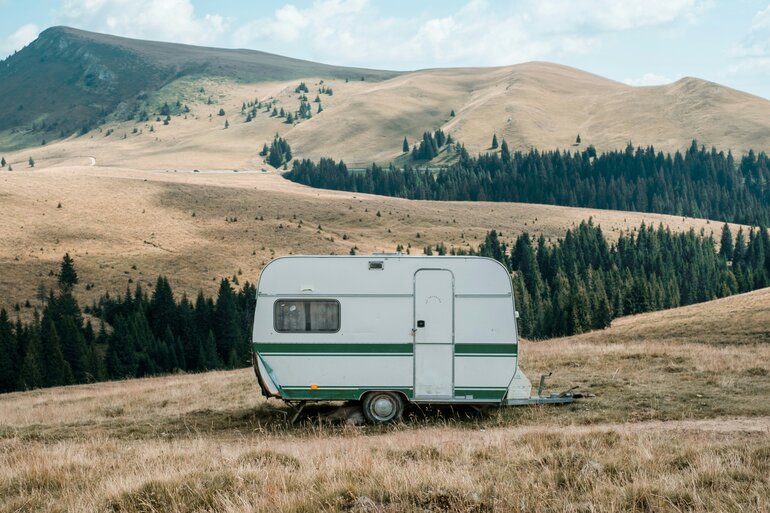
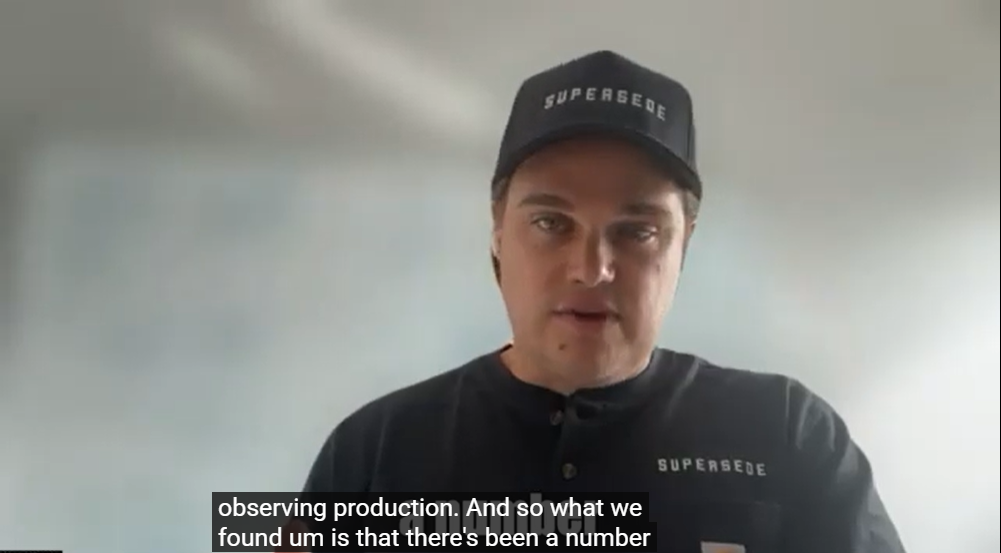
Designed for use in boats, RVs, modular housing, and outdoor construction, Supersede says its panels offer a solution to the escalating volatility and environmental impact of traditional wood-based products. “We’re not selling a green premium,” explained co-founder and chief executive Sean Petterson in an interview. “We’re offering a high-performance material that’s competitively priced and built to navigate the kind of volatility that has become the norm.”
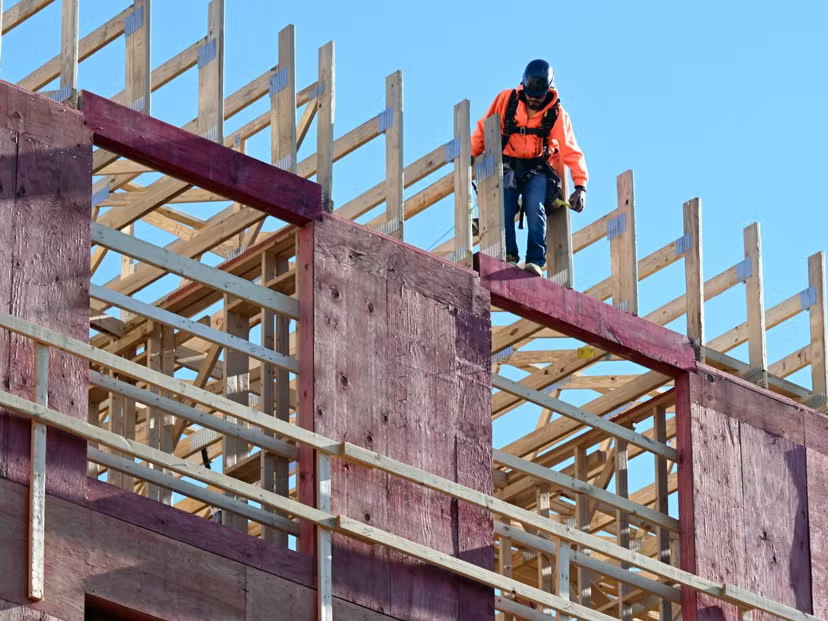
This desire for stability is gaining urgency. In early 2025, the U.S. imposed new tariffs on Canadian lumber, pushing duties as high as 35%. Some manufacturers paused production or abandoned cross-border sourcing altogether so Supersede’s domestically sourced, waste-derived panels offered a reliable, price-stable alternative in a market where certainty is now a competitive advantage.
The funding round, which combined $5 million in convertible debt and $5 million in senior secured equipment financing, was backed by a major U.S. building products distributor, Closed Loop Partners, and several strategic angel investors focused on circular innovation. The capital will fund the development of a second U.S. facility, expected to triple production capacity and create more than 50 new jobs. It’s a significant expansion at a time when many manufacturers are struggling with labor constraints and ongoing supply pressures.
Supersede’s approach, reclaiming unrecyclable post-industrial plastic and turning it into durable structural products, demonstrates the growing appeal of circular, localized manufacturing. “Our customers are tired of the unpredictability,” said Petterson. “They don’t want to be at the mercy of lumber futures or geopolitical headlines. They want reliability.”
Supersede’s model aligns with a growing interest from deep tech investors, who are looking beyond digital platforms to startups reshaping the physical world. The 2025 Deep Tech Opportunities Report, released this month by venture firm DCVC, outlines a decisive pivot away from software-only investments and toward startups focused on making the physical world more stable, scalable, and sustainable. The idea is that resilience, not just efficiency, should be a defining metric of industrial innovation and the report highlights opportunities in waste valorization, modular production, and climate-adapted infrastructure.
Supersede’s panels directly reflect that thinking. They are said to outperform traditional plywood and eliminate the need for sanding, sealing, or drying, streamlining production and reducing labor costs for manufacturers. Supersede also runs a buyback program to reclaim offcuts and used panels, creating a closed-loop system that aligns with growing demand for zero-waste construction inputs.
“We see opportunity for more efficient materials management in the built environment, a sector that often sees high rates of material loss to landfills, and now faces material shortages and delays,” said Kristin Taylor, Venture Partner at Closed Loop Partners. “Supersede is using post-industrial feedstock that is otherwise unrecoverable in traditional recycling markets today. By turning this material into durable building products, Supersede is accelerating a more domestic, value-added, resilient circular economy.”
Supersede is not alone. A wave of hardware startups is gaining traction by solving foundational problems in energy, materials, and infrastructure. Examples highlighted in the DCVC report include Verdox, developing low-energy carbon capture systems; Fervo Energy, advancing next-generation geothermal power; and Twelve, which transforms CO₂ into industrial chemicals, each representing a shift toward deep tech with real-world industrial impact.
Also featured are Alta Resource Technologies, using computational biochemistry to extract critical minerals like neodymium and gallium from e-waste, and Tidal Metals, which is pioneering magnesium extraction from seawater through a novel vapor adsorption system. Like Supersede, these companies are reimagining how essential materials are sourced and produced, favoring circular models, domestic resilience, and scalable infrastructure over legacy global supply chains.
And while Supersede’s model is built on sustainability, it’s performance rather than virtue signalling that drives market adoption. It’s a mindset increasingly common among today’s industrial innovators - solve the hard, physical problems and the market will follow.
The Supersede model speaks directly to the needs of today’s stakeholders. Policymakers want to rebuild domestic manufacturing capacity. Consumers increasingly expect sustainability as a baseline, not a bonus. And manufacturers want materials they can rely on.
“We’re not just trying to make a better product,” Petterson explained. “We’re trying to build a better way to manufacture, leaner, closer to home, and less dependent on fragile infrastructure.”
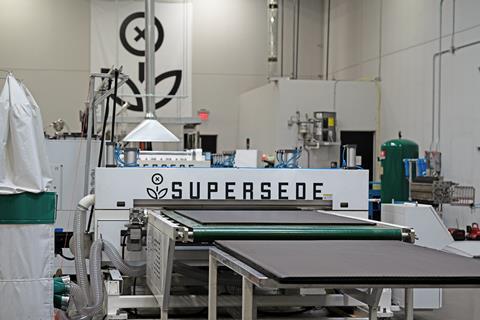
Instead of building one massive centralized plant, the company is rolling out a network of micro-factories. Located near waste streams and customer hubs, these small-footprint facilities are designed to hire locally, cut transportation emissions, and respond quickly to demand. In a world of fragile global infrastructure, Supersede’s model favors modularity over scale and resilience over complexity.
“Ultimately, companies want materials that work,” said Petterson. “Consumers want options they can feel good about. And policymakers want domestic resilience. We’re trying to be where all three of those things meet.”


-p-500.jpg)
.png)
)%20(LinkedIn%20Post)%20(5).png)


.svg)
